Can you get pregnant on your period?

Iona Nelson

Agathe van Lamsweerde

Follows NC° Editorial Policy
At Natural Cycles, our mission is to empower you with the knowledge you need to take charge of your health. At Cycle Matters, we create fact-checked, expert-written content that tackles these topics in a compassionate and accessible way. Read more...
Key takeaways:
- Most people are unlikely to get pregnant on their period, but there is a risk for those with short cycles or longer periods
- You can only get pregnant during the fertile window, which for most, begins after your period has ended
- Tracking your cycle length and ovulation helps you understand your own cycle and fertile window
You can’t get pregnant every day of your cycle, and while it is possible to get pregnant on your period, the chances of this are small. It all depends on your unique cycle. This article will explain the likelihood of getting pregnant on your period and at other times in your menstrual cycle, too.
Can you get pregnant if you have sex on your period?
The likelihood of getting pregnant on your period is low. But for those with very short cycles or longer periods, there is a small chance. To understand why this happens and what the risks are, we need to look at the fertile window and the conditions required for pregnancy.
The fertile window
The fertile window refers to the time in your cycle when unprotected sex can lead to pregnancy. It lasts for six days, encompassing the five days before ovulation and the 24 hours after [1]. The two main factors that determine the fertile window are:
- Ovulation - Each cycle, an egg cell is released during ovulation and survives for up to 24 hours, during which it can be fertilized by a sperm cell, leading to pregnancy. [1]
- Sperm survival - Did you know that sperm can survive in the female reproductive system for up to five days? [1] This means that unprotected sex in the lead-up to ovulation can result in pregnancy, too.
Your uterine conditions also affect the likelihood of pregnancy occurring. Each cycle, the uterus thickens its endometrial lining to support the implantation of a fertilized egg [1]. Your period is a result of this lining shedding, meaning that during your period, the conditions are not ideal for implantation and pregnancy.
Ovulation and cycle phases
When ovulation occurs directly defines the phases of your cycle. The first phase, called the follicular phase, starts at the same time as your period and lasts until ovulation. The length is variable and is determined by the timing of ovulation. On the other hand, the latter phase of your cycle, known as the luteal phase, usually remains stable from cycle to cycle [2], and its length can be used more reliably to predict the timing of your ovulation.
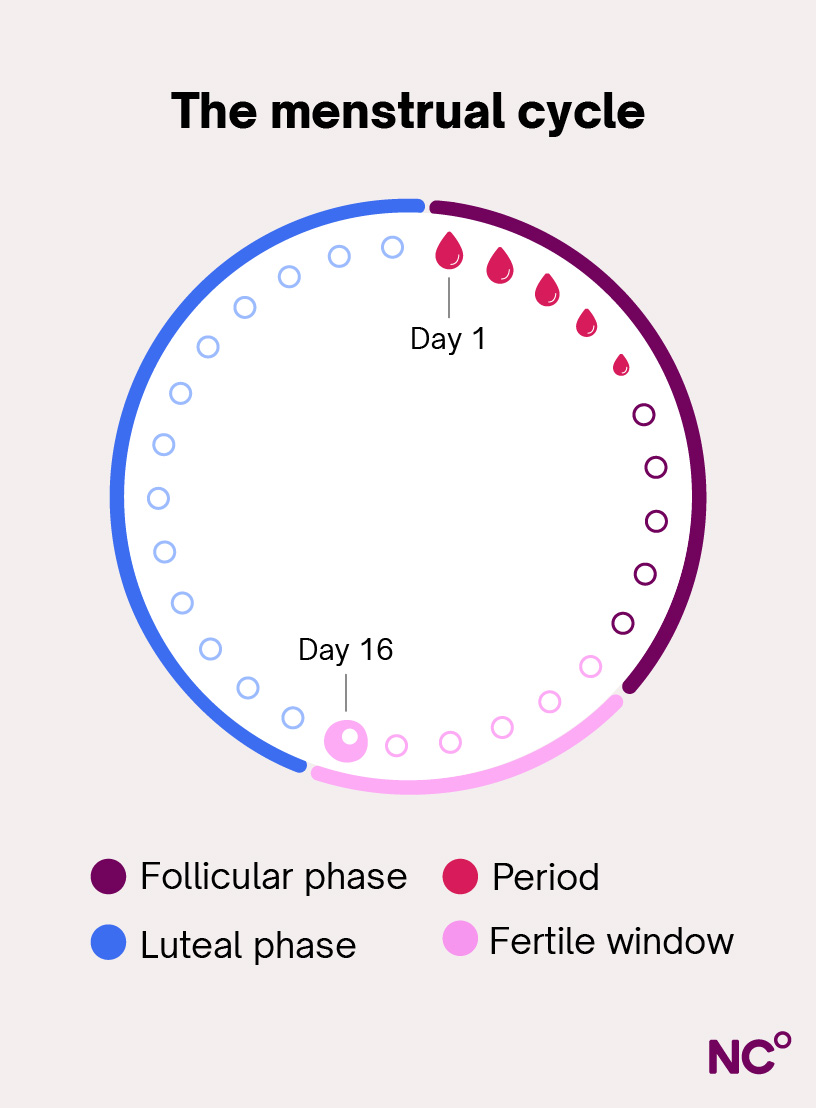
If you have a regular cycle (between 21 and 35 days), your luteal phase — the time between ovulation and your next period — will last an average of 11 to 13 days [2]. Ovulation typically occurs around 2 weeks after your period ends, so the fertile window does not start until after your period has finished [3]. For example, if your period lasts from day one to day five, then you ovulate on day 14, your fertile window will be from day nine to day 14. This leaves a series of non-fertile days from the end of your period (day five) up to the start of the fertile window (day nine).
However, even with regular cycles, ovulation can vary widely from person to person and therefore cannot be accurately estimated from this information alone. Natural Cycles data from over 600,000 cycles showed the average ovulation date is cycle day 17, but ranged from day 10 to day 30 [2].
If your overall menstrual cycle is short (20 days or less), you are likely to have a short luteal phase, or in other words, your chances of earlier ovulation are higher. Earlier ovulation means an earlier fertile window and a higher chance of sperm surviving until ovulation if you have sex on your period.
Similarly, if you have a longer period (lasting more than a week), there is also a risk that the final days of your period overlap with the fertile window. For example, if your period lasts from day one to day five, then you ovulate on day 10, your fertile window will be from day five to day 10, overlapping with the final day of your period.
Can you get pregnant right after your period?
Getting pregnant from unprotected intercourse in the first few days of your cycle is unlikely. However, the more time that passes from the end of your period towards ovulation, the more likely you are to enter your fertile window and risk getting pregnant. Again, the risk of getting pregnant soon after your period is higher for those with shorter cycles or earlier ovulations [3].
Can you get pregnant right before your period?
You are unlikely to be fertile right before your period, as ovulation happens twelve days before your next period on average [2], and the fertile window ends 24 hours after this. But there is a caveat. Predicting ovulation can be tricky without the right tools or knowledge, especially if you experience irregular periods or have a reproductive condition like PMOS (formerly called PCOS). Your ovulation day might move, for example, several days later than usual. If this happens and you have unprotected sex because you assumed ovulation and the fertile window has passed, you risk getting pregnant.
Changes in ovulation are not uncommon and can be caused by lifestyle factors, such as stress or nutritional deficiencies, as well as genetics, autoimmune disorders, hypothyroidism, and hyperthyroidism [4, 5].
Tracking your menstrual cycle helps you understand your unique cycle rhythm, predict ovulation and the fertile window, and, with the right know-how, can be used as a natural way to prevent pregnancy.
Period vs spotting: Chances of pregnancy
Knowing the difference between a period and spotting is key to understanding which phase of your menstrual cycle you are in and your risk of pregnancy.
Your period is the menstrual bleed that happens at regular intervals and marks the beginning of a new cycle, when your uterus sheds its lining. On the other hand, spotting refers to any light bleeding from the vagina that doesn’t require sanitary products [6]. Spotting can occur at any time during the menstrual cycle, and is usually lighter than your menstrual bleed.
There are many reasons you can experience spotting throughout your cycle, such as:
- Ovulation bleeding - One study found that around 5% of participants experienced light spotting midcycle in at least one cycle. It also recorded higher hormone levels in these women, including around ovulation [6]
- Infections - Vaginal or sexually transmitted infections, such as vaginitis or chlamydia, can cause bleeding between periods [7]
- Uterine growths - Fibroids and polyps are non-cancerous growths in or around the uterus that can cause spotting
- Ovarian cysts - These fluid-filled sacs develop on the ovaries, and while they often go away on their own, they can cause irregular bleeding.
- Breakthrough bleeding - This is a type of bleeding that occurs while using hormonal birth control, and is particularly common if you have just recently started using it, or you are taking oral contraception with no break [8].
- Medical conditions - Certain conditions, such as PMOS and hypothyroidism, can cause irregular periods and spotting [9].
- Perimenopause - As we approach menopause, erratic hormone changes can cause irregular periods and unexpected bleeding.
Confusing spotting for your menstrual period, especially ovulation spotting, can increase your risk of pregnancy from unprotected sex. You should speak to your doctor if you experience regular spotting, especially if bleeding is heavy or accompanied by pain.
When to take a pregnancy test
While it can feel daunting, the quickest way to confirm if you are pregnant or not is by taking an at-home pregnancy test. You can take a test from the first day of a missed period (or one day after your period is due). If you are not sure when your next period is due, wait at least 21 days after unprotected sex to take the test [10]. These tests are extremely accurate when taken at the right time and will provide the knowledge you need to take the next steps.
Know your fertility with Natural Cycles
Natural Cycles is an FDA-cleared app that can pinpoint your fertile window and spot patterns in your menstrual cycle. NC° Birth Control offers a hormone-free option to prevent pregnancy, and our state-of-the-art algorithm will let you know when it is safe to have unprotected sex and when you will need extra contraception. You can also track PMS symptoms, learn how long each phase of your cycle is, and know when to expect your period.
Did you enjoy reading this article?
Frequently asked question